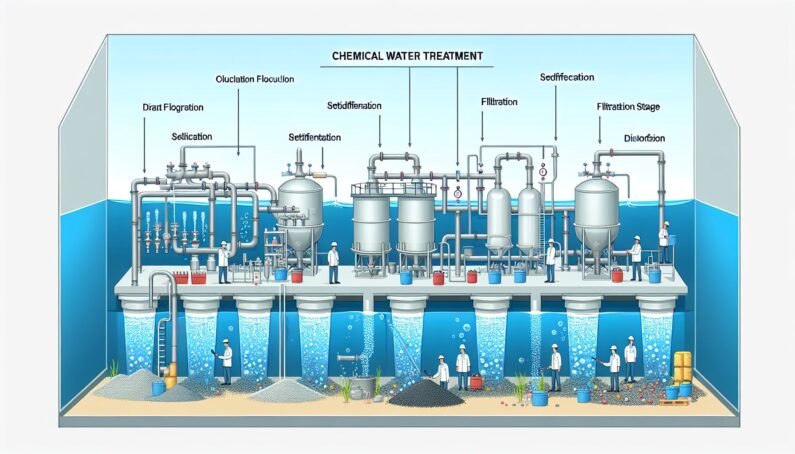
Water is one of the planet’s most vital resources, and ensuring its purity is key for the health and well-being of communities globally. One key method for purifying our water involves chemical treatments, which have been used for decades to refine water’s quality. Still, just like any other process out there, it begs the question, “How can we make it more efficient?” Chemical water treatment process optimization has hence become a major focal point for industry professionals and researchers around the globe.
The Basics of Chemical Water Treatment
Before diving into process optimization, understanding the fundamentals of chemical water treatment is paramount. This technique involves the use of chemical agents to eliminate or reduce pollutants from water. Chemical coagulation, flocculation, disinfection, and pH adjustment are routinely used forms. While quite effective in purifying water, these methods are not without challenges.
Chemical water treatment technologies’ primary purpose is to safely convert raw water into potable water that meets quality standards set by health and environmental agencies. It’s a delicate balancing act—using enough chemicals to neutralize contaminants, but not so much as to harm human health or the environment. Surely it must be possible to get this right more efficiently?
Necessity and Benefits of Process Optimization
Process optimization is fundamental to the continued success of chemical water treatment operations. Why? For starters, optimization can lead to considerable cost savings. Using fewer chemicals and energy not only saves money but also reduces the process’s environmental impact. It’s an absolute must in our quest for sustainable water management.
Optimization initiatives also aim to improve water quality, reduce chemical consumption, minimize waste generation, and enhance overall treatment plant performance. With the global water treatment chemicals market expected to reach a value of USD 65.2 billion by 2027, according to a report by Grand View Research, it becomes increasingly critical to utilize these resources responsibly and efficiently.
The Role of Water Research Foundation
Notably, organizations like the Water Research Foundation are playing an instrumental role in leveraging the benefits of process optimization. Their research initiatives focus on advancing the science of water to improve the quality of life and contribute to a sustainable water management future. Through collaborative research projects, they have helped identify best practices, develop guidelines, and foster innovation in water treatment process optimization.
How can Chemical Water Treatment be Optimized?
Taking a closer look at the optimization process itself, it’s a multi-faceted approach that involves several steps. For instance, let’s consider the example of coagulation optimization.
The coagulation process is a critical preliminary step in many water treatment systems, promoting particles in water to aggregate into larger groups, which can then be removed more easily. Process optimization for coagulation usually involves adjusting the dosage and type of coagulant used, based on the raw water quality. Real-time monitoring of factors such as turbidity and particle size distribution can inform these adjustments.
Furthermore, implementing innovative technologies such as machine learning algorithms or predictive modeling can guide decision-making in real-time. This approach can save time, increase efficiency, and reduce operating costs in the long run.
The Future of Chemical Water Treatment Optimization
With sustainable management of water resources becoming more critical, the future could present significant advancements in the optimization of chemical water treatment processes. The increasing integration of digital technology and advanced data analytics into water treatment operations could play a pivotal role in maximizing efficiency and minimizing environmental footprint. Maybe, water treatment plants will become entirely automated, operating with minimal human intervention.
Additionally, the evolution of green chemistry could revolutionize water treatment operations. From biodegradable coagulants to photocatalytic disinfection, the future of water treatment is pointing towards more sustainable and efficient processes.
The Bottom Line
In conclusion, optimizing the chemical water treatment process is essential to improving the efficiency of operations, reducing costs, enhancing water quality, and moving towards sustainable water management. Organizations like the Water Research Foundation continue to play a critical role in this journey, fostering research and promoting best practices in the field. Innovation is the key to the future, integrating cutting-edge technologies, data analytics, and green chemistry to revolutionize water treatment processes. Who knows what the future holds? But the water sector’s commitment to enhanced efficiency and sustainability is unambiguous.