Water purification is an essential action to secure our good health and our planet’s sustainability. We have seen various methodologies for this purpose, from boiling and filtration to ultraviolet or chlorine treatments. Nevertheless, with the continuous pursuit of innovation in the water treatment sector, ozonation has emerged as a sophisticated technique supporting advanced water purification.
What is Ozonation?
Ozonation is a water treatment procedure that uses ozone (O3), a potent oxidizing agent, to disinfect, deodorize, and decolorize water. Despite its prevalent use in European countries since the early 1900s, ozonation has recently obtained recognition globally, particularly in the U.S., for its outstanding effectiveness in eliminating a broader range of microorganisms compared to traditional chlorination.
A key feature of this method is that it does not introduce chemicals into the water. Here’s a quick question: which would you prefer — chlorinated water with potential harmful residues or ozonated water, leaving no trace of chemicals behind? The answer seems pretty clear.
The Ozonation Process: An Overview
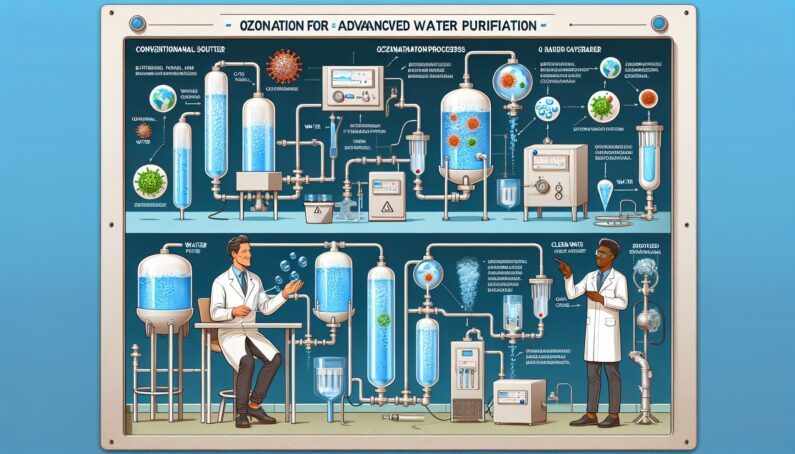
The ozonation process involves generating ozone gas and introducing it into the water. These steps begin with the application of electric current to oxygen (O2), causing it to form ozone (O3). This newly formed ozone gas is then diffused into the water using various methods like venturi injectors or diffuser stones, triggering a series of oxidation reactions.
In simpler terms, think of ozone as a Pac-Man chomping away at the contaminants in your water. When the ozone comes into contact with these pollutants, it breaks them down and effectively removes them.
Ozonation and Its Role in Advanced Water Purification: Why is it Effective?
As per the Environmental Protection Agency (EPA), the key advantage of ozonation over other disinfectants is its ability to mitigate Cryptosporidium, a chlorine-resistant microorganism often found in surface water. Furthermore, The International Ozone Association has found that, compared to the 30 minutes required for chlorine to kill E.coli, ozone kills 99.99% of this bacteria in just 5 seconds.
When you visit the ozonation advanced water purification page at the Water and Wastewater International website, you’ll see that it’s not just about killing harmful bacteria. Ozonation also successfully removes other water contaminants, such as heavy metals, pesticides, and fungicides—something chlorine can’t tackle.
The effectiveness of ozonation goes beyond its potent oxidization properties. Another significant attribute of this purification method is that it degrades into oxygen without leaving behind harmful byproducts or altering the taste and color of the water—creating a holistic purification experience both effective and eco-friendly.
Implementing Ozonation: Key Considerations
Before jumping onto the ozonation bandwagon, it’s crucial to understand that, while very effective, it’s not a one-size-fits-all solution. Factors like water composition, pH level, and temperature can affect the ozone’s effectiveness as an oxidizing agent, thereby necessitating accurate measurement and control.
It’s equally imperative to remember that ozone is a harmful gas when inhaled in large amounts, which may pose safety concerns. Subsequent measures to prevent the gas leakage or having backup safety systems in place are pivotal for this type of water purification system.
The Future of Ozonation
While ozonation might not be the go-to technique for all types of water treatment, its potential cannot be ignored. The technology advancements like ozone production using photocatalytic methods could see a decline in power consumption and operational costs, making the technology more accessible and affordable.
Moreover, with the emerging pharmaceutical and personal care products (PPCPs) pollutants in our water systems, conventional water treatments might not stand a chance. The efficacy of ozonation against PPCPs has already been corroborated by several studies, paving the way for a more encompassing water purification solution.
Wrapping Up
There’s no denying that water quality is the bedrock of overall health and wellbeing. As the need for advanced water treatment methods continues to rise, ozonation holds promise as an effective and eco-friendly solution. With consistent research and technological advancements, the adoption of ozonation could leap from being an alternative to a mainstream methodology in advanced water purification.